
If your website takes longer than three seconds to load on a mobile device, you aren’t just testing your user’s patience—you are actively throwing away over half of your incoming traffic.
In the modern digital landscape, speed is no longer just a technical nice-to-have. It is the single most critical UX feature of your platform. With search engines heavily prioritising user experience signals, technical performance directly dictates your organic visibility and revenue potential.
Let’s examine how Core Web Vitals shape search engine optimisation, what metrics like Largest Contentful Paint (LCP) and Cumulative Layout Shift (CLS) mean in plain English, and how clean code protects your bottom line.
Deconstructing the Modern Performance Metrics
Search engines and browser standards measure user experience through specific quantitative benchmarks known as Core Web Vitals. Understanding these metrics helps diagnose why brilliant designs sometimes fail to convert.
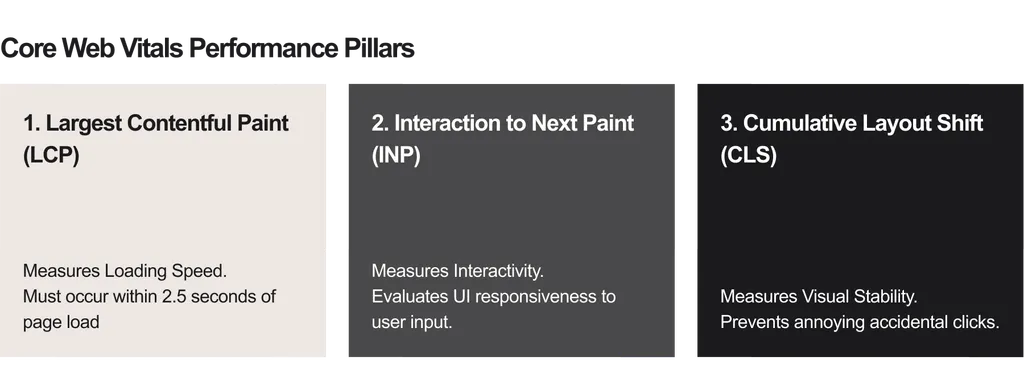
1. Largest Contentful Paint (LCP)
LCP tracks how quickly the main content of a web page becomes visible to the user—typically a hero image, headline, or large video container. If your server response time is sluggish or unoptimised images block rendering, LCP spikes, and users bounce immediately.
2. Cumulative Layout Shift (CLS)
Have you ever tried to tap a button on a mobile site, only for an ad or late-loading image to pop in, shifting the page and causing you to click the wrong link? That is layout shift. Maintaining visual stability is essential for brand trust and accessibility.
How a Sluggish Website Drains Your Marketing Budget
It is easy to view performance metrics as a checklist for developers, but the business impact is staggering:
- The Mobile Drop-Off: Studies consistently show that bounce rates increase dramatically as page load time creeps up. If your ads drive high-intent traffic to a slow landing page, your cost-per-acquisition skyrockets.
- Search Engine Penalties: Slow, clunky sites get buried on page two of search results, effectively cutting off your most cost-effective organic acquisition channel.
- Brand Perception: A sluggish, stuttering UI subconsciously signals to enterprise clients and consumers that your underlying operations are equally disorganised.
Whether we are deploying a streamlined package site or architecting a heavy custom web application, our engineering team at Juicy Media enforces rigorous performance budgets from day one.
Protecting Rankings Through Clean Code & Optimised Assets
Achieving elite performance requires discipline across your entire tech stack:
- Asset Optimisation: Utilising next-gen image formats (like WebP and AVIF), modern lazy loading, and aggressive font subsetting.
- Component Hydration: Minimising unnecessary client-side JavaScript execution in modern frameworks.
- Edge Caching: Delivering static and dynamic assets via global Content Delivery Networks (CDNs) so content loads instantly regardless of geographic location.
Performance is design. When a site is lightning-fast, interacting with your brand feels effortless.
👉 Ready to audit your site’s performance? Get in touch with our team..